Sexual dimorphism in elephant rumbles

I was just getting ready for my day of calculating the ratio of unique words to total words in a bunch of journal articles about spinal cord injury and regeneration when it struck me that there really aren’t enough nice pictures of elephants in our lives. 

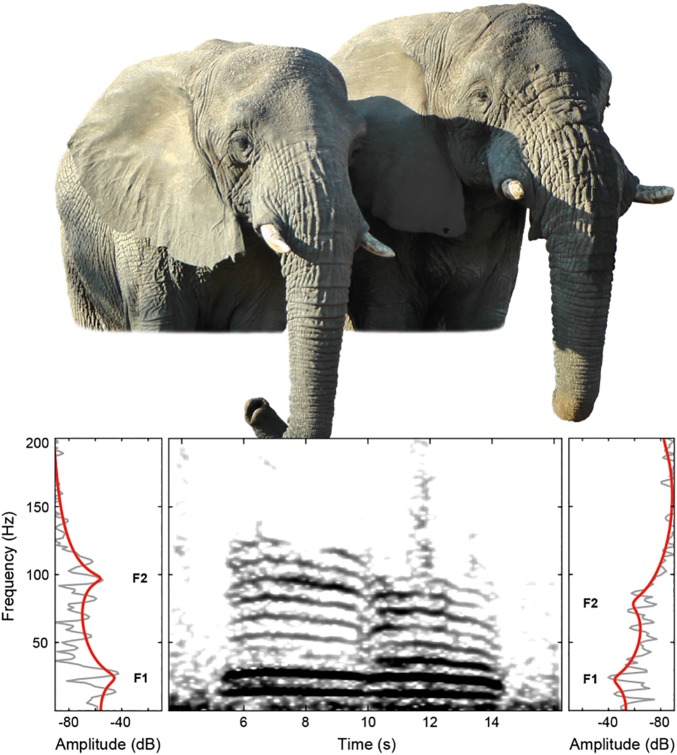
I was just getting ready for my day of calculating the ratio of unique words to total words in a bunch of journal articles about spinal cord injury and regeneration when it struck me that there really aren’t enough nice pictures of elephants in our lives.  Not mine, anyway.  Please enjoy the following picture of Chikwenya (left) and Mike (right), two African elephants from Mana Pools National Park in Zimbabwe.  The wavy lines in the middle of the bottom part of the photograph are a spectrogram of an elephant “rumble.”  See the things labelled F1 and F2 in the panels to the left and right?  Those are the first formant (F1) and second formant (F2) of Chikwenya and Mike’s rumbles.  In a human language, it’s the height and spacing of the first and second formants that identify the various and sundry vowels.  Want to know more about African elephant rumbles?  See Anton Baotic and Angela Stoeger’s recent paper on the topic:

Baotic, Anton, and Angela S. Stoeger. Sexual dimorphism in African elephant social rumblesPloS one 12.5 (2017): e0177411.

Want to know more about formants and vowels?  Encourage me in the Comments section.

Off I go for breakfast (see below) and a nice day of calculating the ratio of unique words to total words in a bunch of scientific journal articles about spinal cord injury and regeneration…
pone.0177411.g001

img_5302
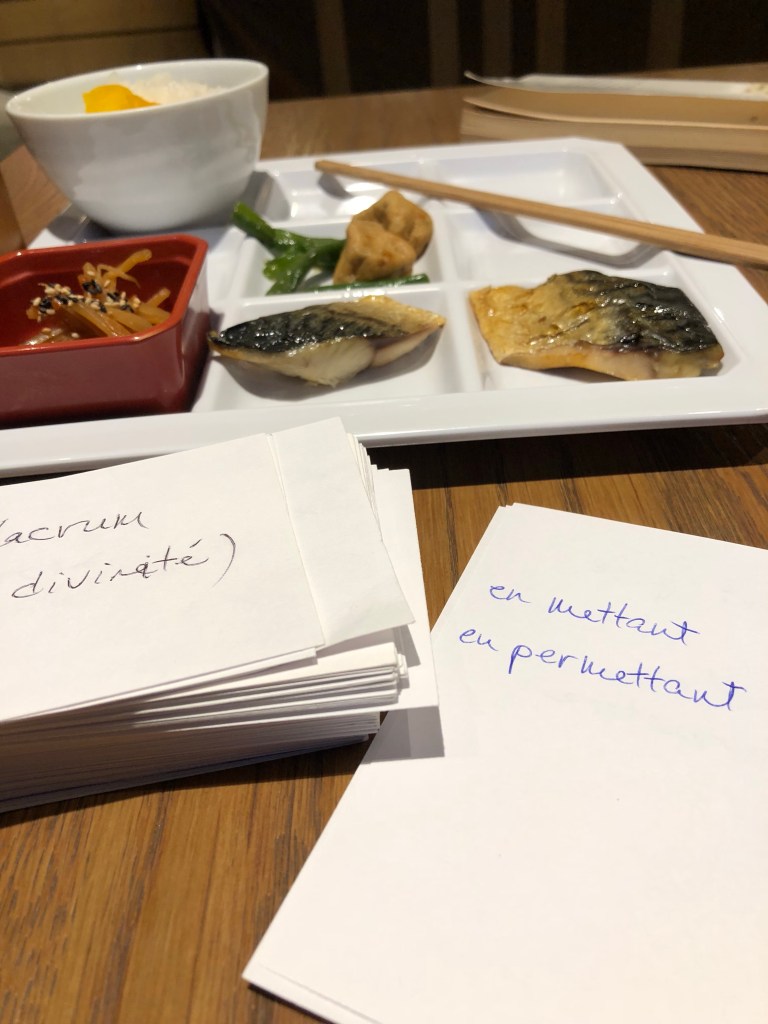
Breakfast in Kashiwa, Japan: grilled mackerel and a bit of French grammar.  Are the “macs” in Jean Genet’s “Miracle de la rose” “maquereaux” (“mackerel”, but also “pimps”)?  I honestly don’t know.

Ah, Josephine, if I dared…

Adventures in anaphora resolution: the Alain Bashung version.

A l’arrière des berlines
on devine
des monarques et leurs figurines
juste une paire de demi-dieux
livrés à eux
ils font des petits
ils font des envieux

What the hell is being delivered, and who the hell is it being delivered to? Livrés is masculine plural.  Berlines is feminine plural, so it can’t be the berlines; monarques is masculine plural, so it could be that; figurines is feminine plural, so it can’t be that; une paire de demi-dieux, I don’t know what to say about.  Demi-dieu is masculine (I think), but une paire is feminine and singular–WTF?  I’ve got livrés narrowed down to monarques or demi-dieux, in any case… Then we get to eux in livrés à eux.  My hypothesis: the figurines are being delivered to the monarchs.  Counter-arguments?

à l’arrière des dauphines
je suis le roi des scélérats
à qui sourit la vie

marcher sur l’eau
éviter les péages
jamais souffrir
juste faire hennir
les chevaux du plaisir

osez, osez Joséphine

plus rien ne s’oppose à la nuit
rien ne justifie

usez vos souliers
usez l’usurier
soyez ma muse
et que ne durent que les moments doux
durent que les moments doux
et que ne durent que les moments doux

osez, osez Joséphine
plus rien ne s’oppose à la nuit
rien ne justifie

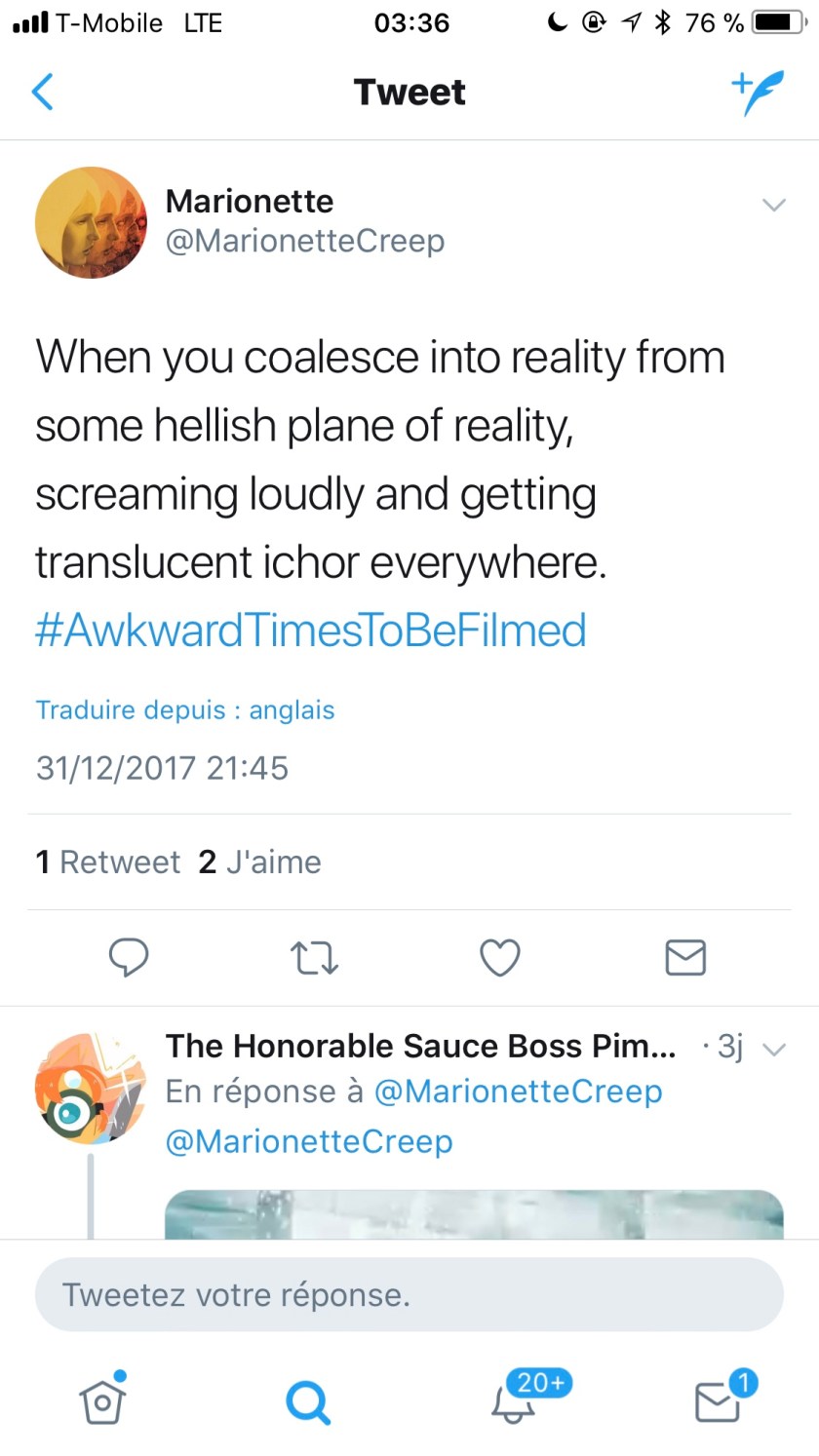
Ethereal fluid

Just for fun: work the word “ichor” into a conversation.

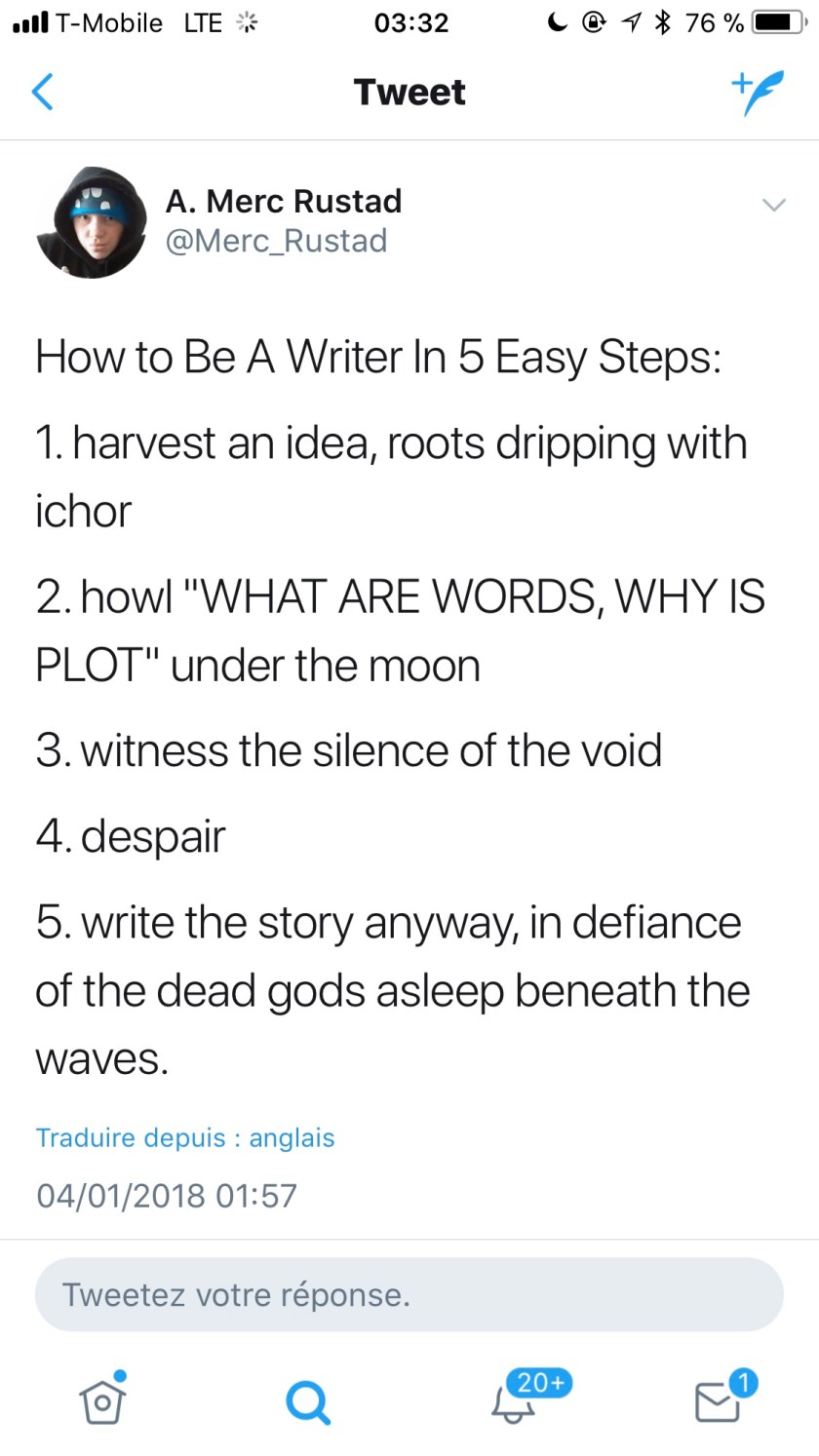
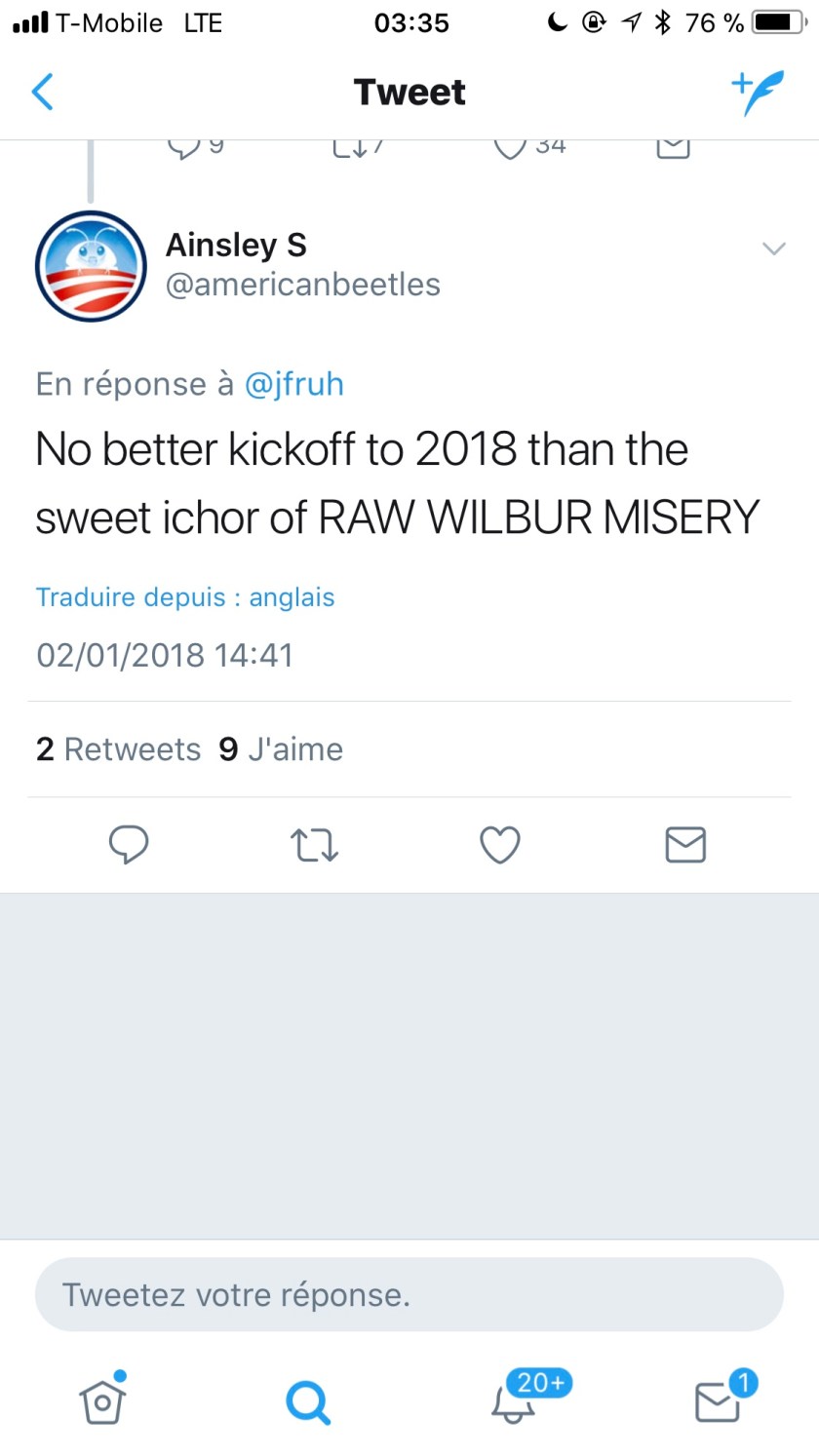
Zipf’s Law: most words occur very rarely–but, they do occur. Case in point: ichor. I went 55 years of my life without ever running into it before that I can recall–and then last year, I came across it twice. (Yes, I remember shit like how many times I came across the word ichor last year–probably why I get divorced so often.)

Is it really possible to use the word ichor in a conversation? As the kids say: hells, yes! For example: I have a bit of a cold, so I spent the morning wiping ichor off of my nose. (Seriously–I feel like shit.) I’m in Hawaii at the moment, so I’m eating a lot of poke–a traditional Hawaiian dish made of raw tuna, which depending on how it’s been marinated, may or may not have a coating of ichor on it. Fastoche–working “ichor” into your quotidian conversations is easy-peasy.


Questions for discussion while you wonder whether or not I’m kidding about wiping ichor off my nose all morning:

  • What does it mean for a word to be in a language?  When I say that ichor is an English word: is it possible, in theory, to demonstrate whether or not that statement is true?
  • Is there some authority that determines what is or is not a word in the English language?  If so: who died and made them king?  (That’s something that kids say when someone who they don’t think has any right to tell them what to do tells them what to do: who died and made you king?)
  • Is being–or not–part of a language purely a question of use?  If so: does frequency matter?  How often does something have to be used to count as part of the language, versus, say, some word that I just made up off the top of my head, or some Yiddish word that I used because I happened to know that my interlocutor would understand it, even though we were speaking English at the time?
  • If it’s purely a question of use: does it matter who uses it?  Like, if a word is only used by adolescent pot-smokers, but it’s used by a lot of adolescent pot smokers–would that do it?  How about if a word is used by exactly the same number of people, but they’re all university professors with doctorates in something cool and tweed jackets?  And what if no one in the entire fucking world except university professors with doctorates in something cool and tweed jackets knows what the hell it means–does that change your judgement?  How about if it’s only one person, but he’s the president of the most powerful country in the world (for the moment, i.e. until he fucks it up)?  Covfefe, anyone?  What if the president uses it, but only one time, and he’s a fucking ignoramus, but then the whole country picks it up, even though it was just a typo, because the president of the most powerful country in the world (for the moment, i.e. until he fucks it up) is too sloppy to be bothered to check his tweets before he hits the Send button?

…or, we could all just step outside for a cigarette and a bit of fresh air.  We are, after all, in Hawaii, and the question of what it means for a language to have something–or not–is really hard to answer.  Tell us about your uses of “ichor” today in the Comments section!

Like, “the”

So true–and probably why I never get a second date…

Nunberg is a super-serious linguist, by the way–and an unusual one, in that he has been very successful in bringing real linguistics to the general public.  Check out his Wikipedia page here.

What’s so interesting about “the”?  Go ahead–tell me what it means.  Hell, forget what it means–just tell me how you know when to–and when not to–use it.


Ukrainian Humanitarian Resistance

Resisting the russist occupation while keeping our humanity

Languages. Motivation. Education. Travelling

"Je suis féru(e) de langues" is about language learning, study tips and travelling. Join my community!

Curative Power of Medical Data

JCDL 2020 Workshop on Biomedical Natural Language Processing

Crimescribe

Criminal Curiosities

BioNLP

Biomedical natural language processing

Mostly Mammoths

but other things that fascinate me, too

Zygoma

Adventures in natural history collections

Our French Oasis

FAMILY LIFE IN A FRENCH COUNTRY VILLAGE

ACL 2017

PC Chairs Blog

Abby Mullen

A site about history and life

EFL Notes

Random commentary on teaching English as a foreign language

Natural Language Processing

Université Paris-Centrale, Spring 2017

Speak Out in Spanish!

living and loving language

- MIKE STEEDEN -

THE DRIVELLINGS OF TWATTERSLEY FROMAGE