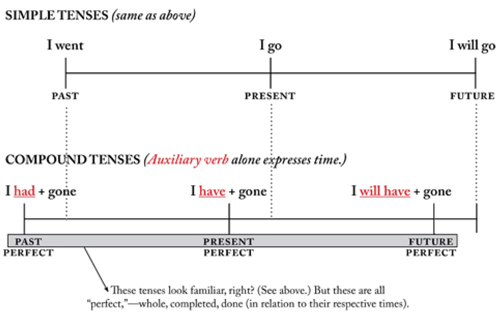
Let’s talk about the plus-que-parfait. This is the French tense (technically, it’s an aspect, but I’ll try to leave the technical stuff out of this) that corresponds to things like I had vomited in English.(More on vomiting below.) In English, we call it the past perfect. It’s what we call a compound tense (see this post for an introduction to compound tenses and what makes them interesting).
If you want to talk about any of the compound tenses with your French teacher, you’re going to need to be able to remember their names. I find it easier to do that if I understand why a tense is called what it’s called, so let’s look at the Wikipedia page on the plus-que-parfait:
The word derives from the Latinplus quam perfectum, “more than perfect” – the Latin perfect refers to something that occurred in the past, while the pluperfect refers to something that occurred “more” (further) in the past than the perfect.
To expand on that a bit: the perfect, in grammatical terms, is used (in English, at any rate) to refer to an action that is completed. For example, while the past tense (a number of past tenses and aspects, actually) in English could be expressed as I vomited, the perfect would be I have vomited. If we wanted to express that the vomiting had been completed even before some other action, then we would use the past perfect: I had vomited. For example: I had vomited twice already before my mother came in and found me with my head in the toilet. Why this is the past perfect: it’s a perfect–a completed action–that is in the past tense with respect to something else. We’ve got two past-tense verbs in that sentence: came, and found. Prior to those events that we’re talking about in the past tense, the vomiting had been completed–in other words, a perfect that occurred prior to–in other words, in the “past tense” with reference to–something else that was in the past itself.
So, on to how to form the plus-que-parfait in French. It’s a simple formula:
imperfect + past participle
We looked at the imperfect in a recent post, so no need to go into that any further right now. The past participle could be any verb, but the imperfect is always going to be either avoir or être, according to the same rules by which you would select one or the other for the passé composé. So, here’s a straightforward example:
Shit, someone just told me that I had vomited yesterday…. (A little coquille (typo) there: it should be on vient, not on viens.)But why has Lassana Bathily who had aided the hostages of the Hypercasher been the only hero “forgotten” by the Legion of Honor 2015?
A nice one, with two examples–one with avait, and one with était:
El-Shaarawy left Monaco. At the same time, no one had noticed that he had arrived….
Here’s one with negation (it’s always important to think about negation early when you’re trying to figure out a verbal system):
The moral of the story of Chloe Florin, it’s that even your closest friends can betray you one day. She hadn’t asked for anything!
More negation:
Remember the time when Louis almost kissed Harry because he hadn’t seen the camera.
Here’s another one with the verb être as the imperfect verb (I know, it’s weird that the perfect is marked with a verb that we call “imperfect,” but that’s language for you–it’s never logical in the ways that one would think it should be):
I dreamt that I met @AjoyfulSquirrel for real and that there was a play Aventures that we had gone to see.
…and, a last one with être to wrap up our introduction to the plus-que-parfait:
He would have met fewer idiots if he had gone to school a little longer to learn to write :-)))))
Click here if you’d like to read more about the French plus-que-parfait.
The famous behavioral psychologist B.F. Skinner maintained that language-learning by children could be explained by the same process to which he attributed all learning: you get exposed to something, you get reinforced. Chomsky pointed out that this couldn’t explain how children learn language, since we can produce and understand linguistic things that we have almost never been exposed. One of my first professors used this example: he must have been being interviewed at that time. If you are a native speaker of English, I would guess that you had no trouble understanding that sentence, and it probably doesn’t seem particularly strange to you. For instance, you might have asked someone why Kevin didn’t show up for a meeting at 9 AM yesterday, and perhaps the person who you asked knows that Kevin was being interviewed for something or other at 9 AM, and answers he must have been being interviewed at that time. However: the sentence is unusual in that it combines every possible place in a sentence where you could use a modal auxiliary in English. (Modal auxiliaries in English are words like must, have (when it modifies another verb), and things like that.) Chomsky pointed out that you will very, very rarely run into structures like that–and yet, as an adult native speaker, you have no problem whatsoever producing or understanding them. This is known as the poverty of the stimulus argument against Skinner’s conception of how children learn language: if you’re not exposed to something, then Skinner has no explanation for how you can learn it. (There are other aspects to the poverty of the stimulus argument–you can see some of them on this Wikipedia page.)
How this fits into my struggles to learn French: I suck at “compound tenses” like “had been interviewed,” and stuff like that. In French, not in English! Objective, third-party evidence of my suckiness in this respect: I recently took a French assessment test on the Lawless French web site, hoping to end up with something like the DALF C1 level that I’m planning to test for, and only got a DELF B1 level! (That’s two below what I was hoping for.) Looking at my results, a lot of my problems came from the compound tenses, of which French has many. So: let’s learn them.
Looking over the various compound tenses in a Bescherelle, they’re somewhat less intimidating than I initially thought, in that as far as I can tell, they’re all formed with one of just two verbs: avoir “to have,” or être “to be.” (Undoubtedly I could have looked this up somewhere, but I remember things better if I figure them out for myself.) Some of the really outlandish ones are formed from tenses of these verbs that one would rarely see–j’eus été–but, you only have to know those tenses for these two verbs in order to be able to form all of those particular compound tenses. Then, as far as I can tell, the last verb in the compound will always be the past participle–so, again, you don’t have to remember quite as much as you might have thought.
With this introduction, we’ll look at some of the compound tenses in future blog posts. I’ll try to make the material less dry by including material from Twitter and the like (if I can find any–see above about the poverty of the stimulus). While you wait, there’s a beautiful page on compound tenses here.
A rather unusual sushi dinner from a recent visit to Japan. If you look closely at the fish that still has its head and tail attached, you’ll see that the rest of the flesh has been removed, leaving only an almost paper-thin body surrounding the spinal column in between the cranial and caudal ends. Picture source: me.
I can’t think about imperfect verbs without thinking of sushi. In the late spring of 2014, just before my first stay in France, I was frantically reviewing all of the grammar that I’m not sure I ever knew. Sitting at a sushi bar not long before my departure, I read about imperfect verbs, and in particular, learnt that they are formed from the nous (first person plural) form of the present tense. Really? I couldn’t recall ever hearing that before–what other simple grammatical facts didn’t I know? Should I be panicking?
Reading a book this morning, I came across a couple sentences–long sentences–in which the majority of the verbs are in the imperfect. It’s a great Zipf’s Law sentence–lots of verbs that aren’t particularly unusual, but that I didn’t know anyway. It also has an amazing array of irregular imperfects, considering that we’re just looking at three sentences here. Let’s look at this little extract–the first three sentences of the nouvelle (short story) Le personnage, “The Character,” by Gloria Escomel (anthologized in Short stories in French: new Penguin parallel text, edited and translated by Richard Coward).
Pierre avait toujours eu peur des atterrissages. Il mâchait rageusement sa gomme pour se déboucher les oreilles, rangeait machinalement livres et revues dans sa serviette, mettait ses lunettes de soleil, les enlevait pour bâiller, essuyer ses yeux, les remettait, se mouchait,enfouissait son mouchoir au fond de sa poche, le serrait convulsivement…Il sentait croître la peur, une peur absurde, irrationnelle; des mots sourdaient de lui, qu’il marmottait sans leur prêter attention.
“Pierre had always been afraid of landing. He furiously chewed his gum to unblock his ears, mechanically tidied away books and magazines in his briefcase, put on his sunglasses, took them off to yawn, to wipe his eyes, put them back on, blew his nose, burying his Kleenex in the bottom of his pocket, squeezed in convulsively…He felt the fear growing, an absurd fear, irrational; words sprang to his mind, which he muttered without paying attention to them.”
Imperfect verbs are formed from the nous (first person plural) form of the present tense of the verb. So, here are some verbs that are regular in the imperfect (examples taken from Laura Lawless‘s page on the imperfect on About.com, because I’m too lazy to go downstairs and get a grammar):
parler
finir
je
-ais
parlais
finissais
tu
-ais
parlais
finissais
on
-ait
parlait
finissait
nous
-ions
parlions
finissions
vous
-iez
parliez
finissiez
ils
-aient
parlaient
finissaient
You’ll notice that the inflections are all pronounced the same, except for nous and vous, so as long as you remember -ions and -iez, you’ll be fine. (Predictably, these are the ones that I mess up most often.)
Let’s see some reflections in the sentence of the fact that the imperfect is formed from the stem of the nous present tense form. The main consequence of this is that we’re going to have some stem consonants that we wouldn’t have seen in the third person present tense. In particular, look at enfouir, “to bury.” The imperfect is enfouissait. Where does the ss come from? Because although the third person singular present tense is enfouit, the first person plural form of regular ir-class verbs is enfouissons (see here if you need a review), and that’s the form on which the stem of all imperfects is based.How about the double tt in mettait and remettait, when the third person singular present tense is met,with a single t?It’s because the first person plural present tense is mettons (and remettons). (Note that that is not the cause of the tt in marmottait (he mumbled, he murmured)–the infinitive is marmotter, so even the third person singular present tense has marmotte, i.e. two tt’s.
Ranger has yet another irregularity. You’ve noticed that the third person singular imperfect ending is ait. So, where does the e come from in rangeait? We could just say that it comes from the fact that the first person plural present tense has it, too–rangeons– but, that just pushes the question off to why the first person plural has it. Here, it’s just a spelling thing. To indicate that the g is pronounced like zh, it needs to be followed by an e. That e is not, itself, pronounced–it just reflects the fact that the g is “soft.” (That’s a non-technical term! Technically, it’s a fricative, as opposed to the g without e or i after it in the spelling, which is what’s called a stop.)
Let’s move on to sentait, “he felt:” Il sentait croître la peur, he felt the fear growing.” This comes from the verb sentir, to smell. We saw that the other ir verb that we’ve seen in the story has ss in the stem–why not sentir? You might remember from an earlier post on ir verbs that sentir is irregular, and has the basic form of a regular er verb in the present tense. So, the first person plural (nous) form is sentons, and the imperfect is sentait.
For the last irregular verb in the sentence, let’s look at avoir, “to have,” as in Pierre avait toujours eu peur des atterrissages–“Pierre had always been afraid of landings.” (We’ll ignore for now the fact that this is one of the compound tenses: avoir eu.) Avoir is one of the most irregular verbs, but it’s actually fairly simple here–the nous form is avons, and avait thus looks pretty much like any other imperfect. (I call it “fairly simple” because the present tense nous form of avoir has the same root as the infinitive, unlike most of the present-tense forms of that verb.)
For thoroughness, let’s include the imperfect of the verb être “to be,” even though it doesn’t show up in our sentence–irregular, as always. Just remember that the stem will be ét-:
j’étais
nous étions
tu étais
vous étiez
on était
ils/elles étaient
In the end, I messed up the nous and vous forms countless times by forgetting about the i, but the rule of forming the imperfect from the present tense nous form isn’t that difficult to remember, and I don’t think that I caused any diplomatic incidents by forgetting it, despite my sushi-related insecurities. There are more irregulars in the imperfect related to spelling changes (see ranger above–there are lots of others), but from the point of view of the spoken language, it’s fairly straightforward to use.
There’s a whole nother issue related to this example, which is: why did the author use the imperfect? These are “punctual” occurrences, meaning that they happened just once, so you would expect either the passé composé or the passé simple. A mystery–feel free to explain in the comments, if you know.
Update, January 4th, 2015:
Here’s a nice application of the imparfait. You can use it to make suggestions by preceding it with et si. You would translate et si + imparfait as something like “how about” or “what if.” See the Lawless French web site for more on this.
What if we took 1 minute to change everything today? How about taking 1 minute to change everything today?










 Zipf's Law