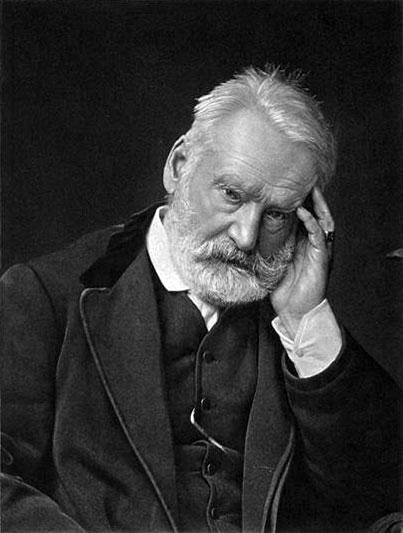
Victor Hugo is well-loved in America for Les misérables–not for the book, but for the English-language musical that was made from it in 1980. (It’s so popular that it has a nickname: Les mis.) Even children know him; or, more accurately, know of his work, through the Disney film The Hunchback of Notre Dame–Quasimodo is a character recognized throughout American culture.
Hugo was a complicated guy. He started out as a conservative, then became so vocally opposed to the dickwad “emperor” Napoléon III that he had to go into exile. (Dickwad explained in the English notes below.) He returned to Paris when the Second Empire fell, and stayed there through the Prussian siege of Paris in 1870-1871 and the Commune (my favorite of the four French Revolutions). He fought against the death penalty, but was very much in favor of the colonization of West and North Africa; unlike many of his generation, he never spoke out about slavery. Wikipedia lists a couple of long-term mistresses and lots of casual affairs–he was sexually active until a few weeks before his death at the age of 83. (Reminds me of my French grandfather, who fathered my mother and aunt in his sixties. ¡Muy fuerte!, as a Mexican friend said when I told him the story–I will not try to describe the accompanying gesture.) He also seems to have been devoted to his children, both legitimate and extra-marital.
His poetry is far less known than his prose, but this being National Poetry Month, today I’ll give you a poem of his that I love. It’s one of those things that is dear to me not because of the poem itself, but because of my associations with it, so you might not love it quite as much as I do. Nonetheless: it’s a good one–if, like me, you are trying to learn to speak French, I recommend that you spring $0.69 for the recording and explication of it byof the French Today series of French-language instructional materials. Here’s the poem, and don’t forget to scroll down for the English notes, where I talk about the noun dickwad and the phrasal verb to spring [quantity of money] for [something]. Native speakers (of French): there are also a couple of French questions at the bottom of the page.)
Elle était déchaussée, elle était décoiffée
–Victor Hugo
Elle était déchaussée, elle était décoiffée,
Assise, les pieds nus, parmi les joncs penchants ;
Moi qui passais par là, je crus voir une fée,
Et je lui dis : Veux-tu t’en venir dans les champs ?Elle me regarda de ce regard suprême
Qui reste à la beauté quand nous en triomphons,
Et je lui dis : Veux-tu, c’est le mois où l’on aime,
Veux-tu nous en aller sous les arbres profonds ?Elle essuya ses pieds à l’herbe de la rive ;
Elle me regarda pour la seconde fois,
Et la belle folâtre alors devint pensive.
Oh ! comme les oiseaux chantaient au fond des bois !Comme l’eau caressait doucement le rivage !
Je vis venir à moi, dans les grands roseaux verts,
La belle fille heureuse, effarée et sauvage,
Ses cheveux dans ses yeux, et riant au travers.
English notes
dickwad: jerk, asshole. Like many other English-language slang terms for jerks, it is derived from a slang term meaning penis–in this case, dick, which is not quite baby-talk, but is nonetheless somewhat childlike or, at any rate, not very sophisticated. And yet: don’t say it in front of my grandmother.
to spring for: to spend money on something. It can have an implication of spending money for someone else, specifically, especially in the third person–but that is not necessarily the case. Some examples (invented by me, for clarity):
- I’m short on money right now, but yesterday I sprung for a book on famous Second Empire courtesans. Tourists today would never guess what went on in the Palais Garnier in those days… No implication that it was for someone else here–it’s clear from the context (at least to a native speaker) that I bought the book for myself. (…and I did!)
- My fucking parents won’t spring for week in Mexico for spring break. (Here it’s pretty clear that the spoiled college student (not me) is complaining about a third party–his parents–not being willing to underwrite the expense of this particular “spring break” (school vacation around Eastertime) adventure for him.
The expression can also include a specific amount of money, in which case it is the direct object of the verb:
- I recommend that you spring $0.69 for the recording and explication of it byof the French Today series of French-language instructional materials. (That’s from this blog post.)
- I’m short on money right now, but I sprung $3.50 for a short book on the Battle of Waterloo yesterday. (…which is absolutely true!)
…and yes, the past tense (and past participle) of to spring is sprung.
French question
Native speakers: in this context, how would you interpret riant au travers?
For LG, la fée que je crus voir.