There are approximately three and a half ways for medical professionals and paraprofessionals to volunteer in Ukraine. By “medical professional” I mean most of the specialties that require a bachelor’s degree or higher: for example, doctors, nurses, and physical therapists. By “medical paraprofessional” I mean any specialty that requires less than a bachelor’s degree, such as combat medics and blood bank technicians. Medical professionals have approximately four options. Paraprofessionals have approximately three options. The difference is that professionals have more volunteering options within hospitals in general, and civilian outpatient clinics in particular. Wherever you fit into the hierarchy, here is a good piece of advice: bring copies of your certifications, licensure, driver’s license, passport or visa, training course diplomas, DD 214, vaccination record, and anything else that documents your skill set and your suitability for work in health care. I recommend bringing both scanned and printed copies.
With one exception, I’m going to talk here only about organizations that directly support the army, and only about organizations that are completely or almost entirely focused on medical care. The number of potential organizations expands for those who are open to doing hot extractions of civilians. (“Hot extractions” means evacuation of civilians from the front.)
Medical volunteering opportunities in Ukraine can be separated into four categories, distinguished from each other by proximity to the front. Drones have made “the front” much deeper than it has ever been in the past, and no part of Ukraine is out of the range of ruzzian drones, and the ruzzian army has struck medical facilities and personnel with great eagerness since at least the start of the full-scale invasion in February of 2022. (I would give you statistics, but they would be out of date before I had my post-blog-post cigarette. Suffice it to say that most of the people I know who were killed in Ukraine were in a clearly marked medical or humanitarian vehicle when the ruzzians did it. Yes, that is a war crime. Interesting data point: in other recent wars, attacks on health care have tended to be at their highest at the beginning of the shooting, and then taper off. In contrast, ruzzia has repeatedly surged its numbers of attacks on Ukrainian healthcare facilities and personnel. See Figure 2 of this 2025 paper by Usmany et al., and compare it with Figures 1 (Myanmar) and 3 (Lebanon).)
Here are the four categories that I will refer to. Except for the last one, they all involve working with military units. You will note that these categories also relate to the kind of medical care that you will be rendering.
- Kinetic: guaranteed to involve close proximity to violence, with the possibility of needing to shoot back.
- Moderately kinetic: typically involves close proximity to violence, including being within range of artillery, bombs, land mines, snipers, missiles, and of course drones, but usually beyond the range of small arms fire (rifles, pistols, and some light machine guns).
- Hopefully not too kinetic: Within the range of artillery, bombs, missiles, and drones, but beyond the range of small arms fire (except for raids by ruzzian special forces, which does happen).
- Kinetic only in the case of war crimes: This includes medical facilities everywhere in the country outside of the “yellow zone.”
Different kinds of medical care happen in the four different categories. So, with our kinetic categories established, let’s talk about the different kinds of medical care and volunteering possibilities that take place in them. For every option, I will give some pluses and minuses.
Kinetic: Combat medic (in the American sense of that word) in the Armed Forces of Ukraine. The vast majority of foreigners in the army are in the infantry or reconnaissance. Other possibilities exist, but are REALLY hard to pursue successfully without solid Ukrainian language skills. Within the army, speaking both English and Spanish or Portuguese will open some doors for you that might not be open to others, but you might not necessarily want to walk through those doors. Plus: joining the army removes the visa question, since your military papers are your visa equivalent. Plus: the military is a Ukrainian organization, and Ukrainian groups tend to be the most efficient. Plus: you get a paycheck and food/board/uniforms/kit/medical care. Plus: if you are injured, you will receive good medical care and rehab. Plus: you qualify for Ukrainian citizenship. Minus: I don’t actually have any minuses for this option, personally, but you should read George Orwell’s Homage to Catalonia before choosing this option. The book tells of his service as a foreign volunteer fighting the Fascists during the Spanish Civil War. Nothing about the experience of volunteering in somebody else’s army has changed since it was published–in 1938.
Moderately kinetic: join the Hospitalières Medical Battalion. Hospitalières work the entire scope of the evacuation chain–CASEVAC, MEDEVAC, stabilization points, and mobile ICU. (CASEVAC is evacuation of casualties away from the front in a non-medical vehicle. Medical care during CASEVACs is usually limited to hemorrhage control and airway maintenance. MEDEVAC is evacuation of casualties from the front or from the red zone in a medical vehicle. Medical care includes hemorrhage control and airway maintenance, and extends to intravenous access, pain control, and treatment of other injuries. I will explain stabilization points below.) Huge plus: 100% volunteer unit, which is important because volunteers are the best people in the world. Plus: a Ukrainian organization. This is a plus because Ukrainian volunteer groups tend to be more efficient than foreign volunteer groups. Plus: you have choices about what kinds of rotations you do (CASEVAC, MEDEVAC, etc.) and where you do them. The battalion uses a request system that lets you specify a lot about what your next rotation will look like. With some planning, you can also control who you do it with–teams can jointly request specific rotations. Plus: you have a lot of control over the pace of your work. Typical rotations are two to four weeks long. You can do them as often as you want, and some foreign volunteers stay in the field almost constantly. You can also deploy much less often, and take as much time as you need for other volunteering projects in between. Minus: as a foreigner, it can be difficult to figure out how to join the battalion. Minus: because the Hospitalières Medical Battalion is a paramilitary organization, administratively external to the Armed Forces of Ukraine, its funding is dependent on donations, and you should plan to do some fundraising. Food, boarding, uniforms, kit, and medical care are provided. You’re on your own for spending money.
Hopefully not too kinetic: Join one of the small number of foreign volunteer organizations that work in stabilization points. A stabilization point is the first medical facility that a casualty reaches. It is typically the first time that the casualty will be treated by a doctor. The level of care is above that of a casualty collection point, but below that of a hospital. Stabilization points are military facilities, but in rare instances are staffed by foreign volunteer organizations. As I write this (in September of 2026), I would estimate that there are two or three such stabilization points in Ukraine. Stabilization points are typically within the range of tubed artillery. They do get attacked, both by standoff weapons and (rarely) by special forces infiltrators. Their vehicles are also targeted by the ruzzians, just like they target every other medical vehicle. Off the top of my head, I can think of four people killed and a few badly injured while driving out of or into stabilization points. Plus: you will use your skills more in a stabilization point than in any other environment that I have worked in in Ukraine. CASEVAC and MEDEVAC work is mostly sitting around waiting for a call–the rate of arrival of patients to stabilization points tends to be much higher, and more constant. Plus: you will meet far more Ukrainian medical personnel in a stabilization point than elsewhere, and that is an excellent way to get a variety of perspectives on the nature of the experience. Minus: because a stabilization point is more established and has larger teams than you would have on a CASEVAC or MEDEVAC rotation, it can be more complicated to integrate yourself into the team than on the more kinetic kinds of crews. Minus: in a stabilization point, you are going to see a lot of ruzzian-induced misery, and it will piss you off/horrify you, but you will have absolutely no opportunity to shoot back. Minus: I’m talking specifically about foreign organizations here. It is worth repeating that Ukrainian organizations tend to run more smoothly than foreign ones. This is not surprising, since Ukrainian organizations do not have language issues, and they know the culture within which they are working. Problems related to foreigners working with Ukrainians are rare. Problems of foreigners working with other foreigners are not necessarily common, but they do happen and can be severe.
Not kinetic, unless the ruzzians decide to drop a missile on your local train station, shopping center, or maternity hospital: inpatient care, or outpatient care for refugees and/or civilians in liberated areas. There’s a lot of need for this, and I hear that a lot of that need is in the extreme west of the country, where your chances of getting hit by a missile are far lower than your chances of dying of random gun violence in the US. Pluses and minuses: I don’t know of any, never having done civilian medical care in Ukraine.
Scope of practice
Ukraine has a legal framework in place that allows foreigners to work in a medical capacity. Standards of practice and the level of care that you are legally permitted to provide will be similar to what you are used to in your home country. Do not assume that being in a combat zone means that you can work beyond your level of training and certification!!! (I would add more exclamation points there, but it’s visually unappealing.)
Final thoughts…
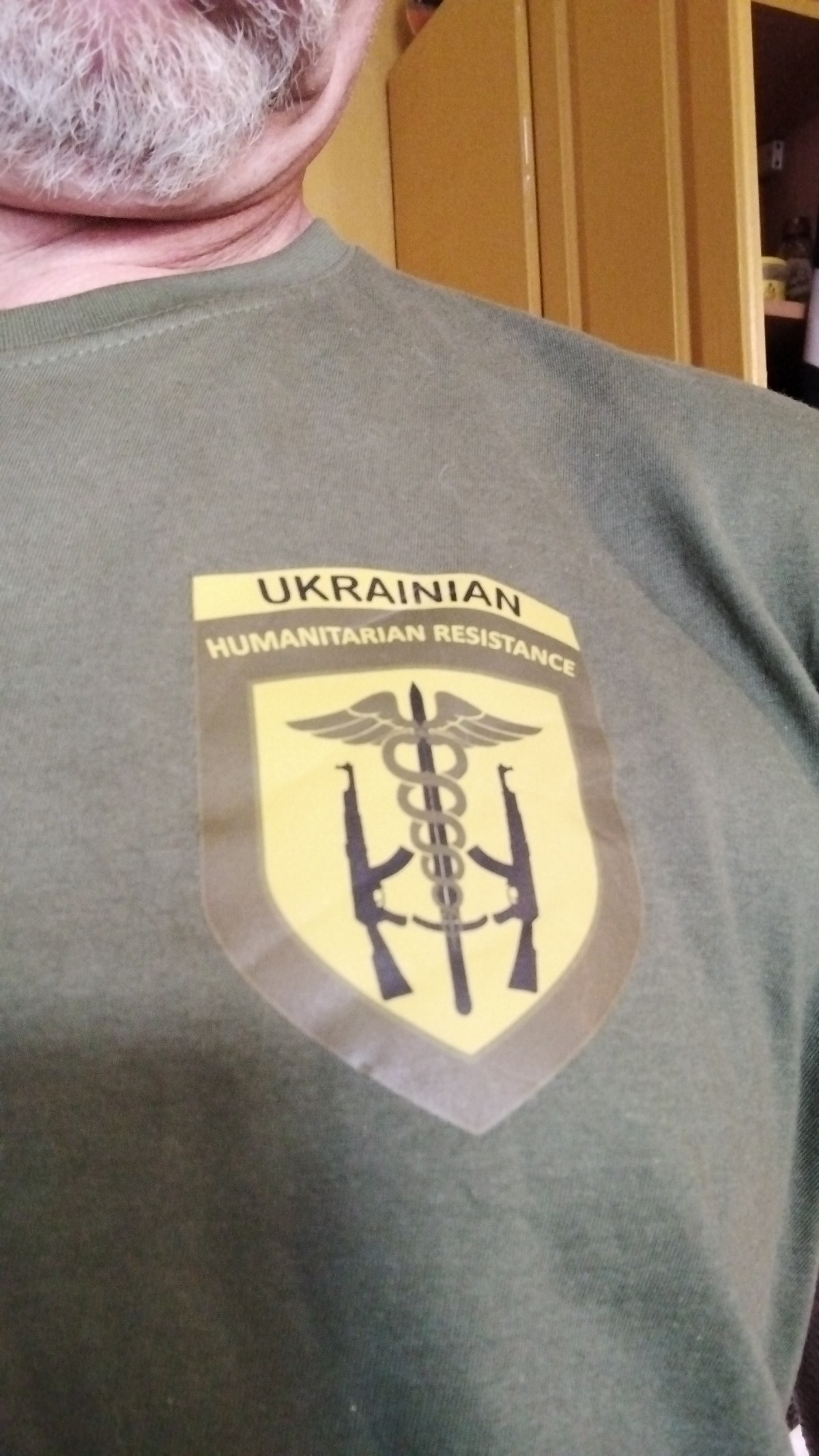
I should add one more thing here… Medical work in a combat zone wore me down in ways that I have not been worn down before, to the point that after four and a half years in Ukraine, I left the medical field and became a gunner in an anti-aircraft unit instead. I continue to do medical logistics work as the director of the American 501(c)3 Ukrainian Humanitarian Resistance. If you would like to support our work, I will put donation information below.
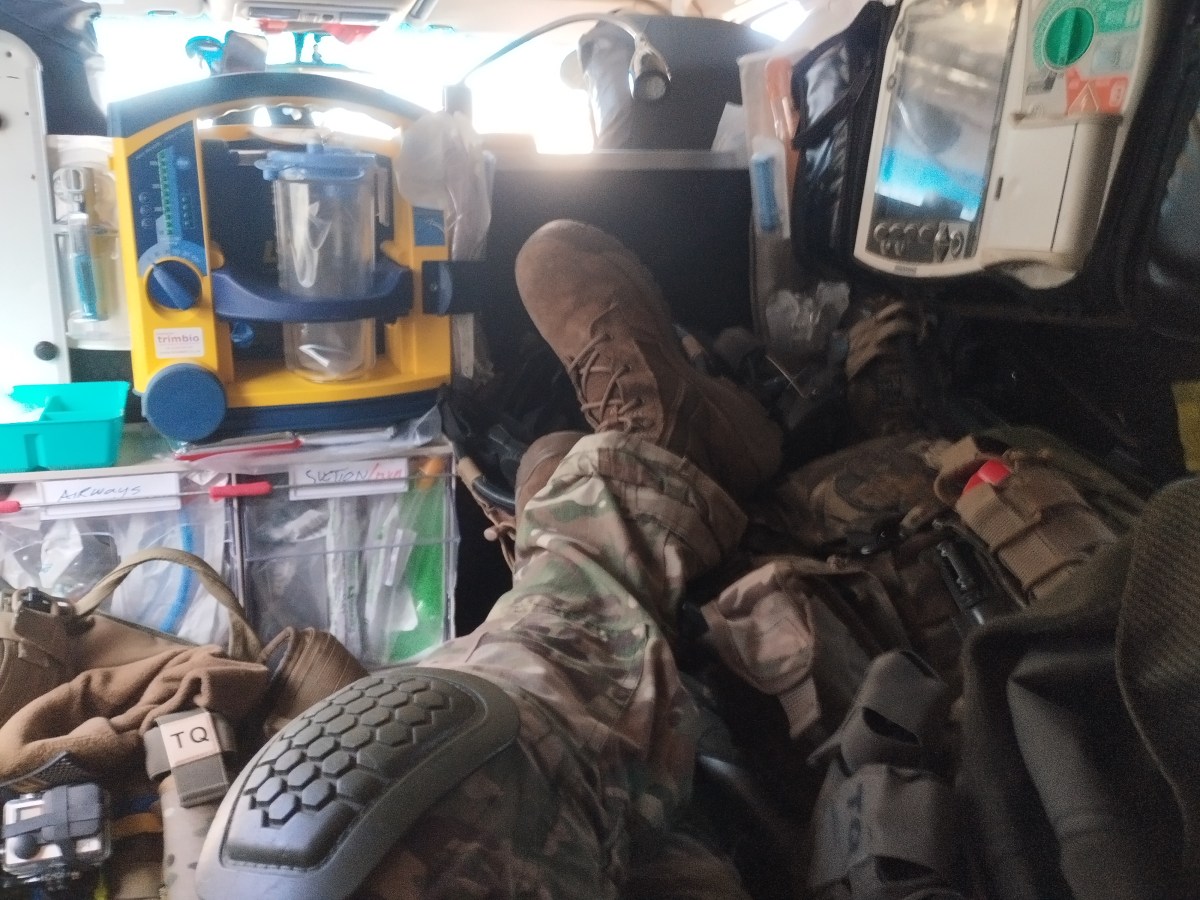
The photo at the top of this post is of me on the way to the southern front in the back of an evacuation vehicle in the summer of 2024.
My name is Kevin Bretonnel Cohen. I serve in the Territorial Defense Forces of Ukraine, and also am the director of the American non-governmental organization Ukrainian Humanitarian Resistance (501(c)3, EIN 99-4530777). Ukrainian Humanitarian Resistance specializes in supporting platoon-level combat medics, and is also involved in public health and in nursing education. If you would like to support our work in Ukraine, PayPal to kevin.cohen@gmail.com works fine, as does Zelle to 303-916-2417. If you use PayPal, please be sure to choose the Friends and Family option, so that your donation does not get deducted from my Social Security check. However you choose to help, please be sure to add a message with your contact information, so that I can thank you!
All views expressed in this post are my own.